By Garry Sanossian
Across Australia, churches are asking a familiar question in a changing world: how do we faithfully live out the way of Jesus in our communities today? The newly launched Kenmore Institute for Church Planting at Australian College of Ministries (ACOM) is addressing that need by equipping leaders and helping local churches take root in their communities.
Led by Steve Gray, a pastor and missional leader with over a decade of experience, the Institute is grounded in church planting and renewal.
A decade ago, Steve and his wife stepped into Burleigh Heads Church of Christ on the Gold Coast and began reconnecting with the community and reshaping church life.
“We essentially took on a church that needed a new life,” Steve said. “Over time, it came back to life. It’s now full of new people, new families and new energy.”
That experience now shapes the Institute’s vision. Rather than offering quick solutions, the Kenmore Institute is focused on forming leaders who can discern what God is doing in their context and respond with faithfulness.
“There’s no secret formula for church planting,” Steve said. “It’s about being ready for what God wants to do and learning to move at His pace.”
For ACOM Principal and CEO Neale Meredith, the Institute also carries a significant legacy. The name Kenmore honours Kenmore Christian College, which was established in Queensland in 1964 before later becoming part of ACOM’s story.
“The Kenmore part of it was an attempt to recognise and honour the legacy of the Kenmore Christian College,” Neale said.
“To create something that the movement of churches in Queensland for Churches of Christ could identify with.”
As part of ACOM, the Institute brings together theological training and real-world practice.
“As I met with leaders of our movement across the country, it became very clear that church planting was high on everyone’s agenda,” Neale said.
In response, ACOM began developing church planting pathways beyond a single subject or short course, creating diploma, bachelor and master’s awards that Neale described as the first of their kind in Australia.
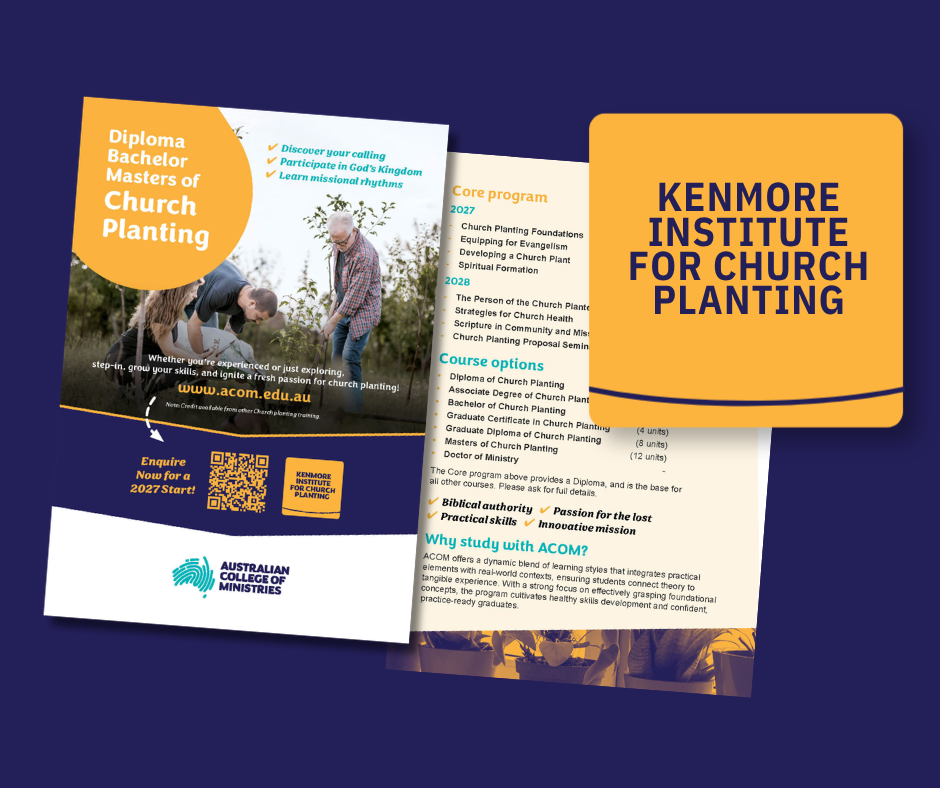
From traditional church plants to new expressions shaped in everyday life, the goal remains the same: building Jesus-centred communities in local contexts.
“The heartbeat is not just to plant churches,” Steve said.
“It’s to see people transformed by Jesus.”
At its core, the Institute meets a growing need for leaders formed for ministry today. Its focus is shaped around three priorities: exposure and permission, community and cohorts, and patterns and practices.
“We want to give students exposure to all of that and help them find what suits them,” Steve said.
The Institute is not just about classroom learning but formation in real ministry contexts.
“We don’t just want to teach,” Steve said.
“We want to form people in the context of real ministry. Church planting is incredibly hard but it’s also incredibly beautiful.”
Neale said the Institute is also responding to a wider movement across the Australian church.
“One of the clearest things that’s been emerging for us is seeing a growing hunger for church planting and renewal and missional communities and innovation in how we go about doing church,” he said.
“If we can see leaders developed who are deeply formed, who understand their communities, and who can lead in a sustainable way, that can shape the Church for decades,” Steve said.
The Kenmore Institute exists to see that kind of leadership take root, so that more communities might encounter Jesus in lasting ways.
If this sparks your curiosity, feel free to reach out to Steve Gray: sgray@acom.edu.au or read more about Kenmore Institute at acom.edu.au/about/schools/kenmore-institute
Page Feedback